

Nettle oil and overnight infusion: Along with the sting, the seeds and the root, these are two of the most common ways we work with Nettle at the school. This page gives a short guide to making both of these.
🌱 Asking and intention
Take time to connect to the Nettles and ask if it is ok to harvest some before diving in. This process of asking invites you to listen to your deeper knowing – I was never fully convinced about this when I started as a herbalist, until one day I asked Yarrow if I could collect some, and the ‘No’ was so distinct and immediate it help me see the gentle flowing ‘Yes’ that I was more familiar with. There’s a lot to unpack in this process of asking – not least the clarity of your intention and what you intend to do with the preparations. In my early days as a herbalist I would often harvest, dry and prepare too much, ending up with dried herbs and preparations years later that I never used. As time went on this felt disrespectful to the plant and I’ve gradually refined this down to only taking as much as I will really make use of in the following year. If this is for personal use, it can actually be very little – a few hundred grams of dried herb, a half litre of tincture, oil and hydrosol etc.
🌱 Process and outcome
My experience is that the quality of intention going into every stage of harvesting and preparing is important – it is as much about the *process* of making as the final result. This is a key theme in Alchemy, that the process matters and the intention you bring is carried into the final preparation. If you are new to these Nettle preparations, don’t worry too much about this first time, as this is a first ‘getting to know’ stage. However as you start to develop more of a feeling for the plant and the preparations, more clarity and intentionality can be brought in.

I’ve harvested around 15 young Nettle stems ready to prepare and have a pan ready for the infusion (stainless steel ideally) and a glass container for the oil. Alternatives for both would be vacuum flasks, which work remarkably well for long heat infusions.

Nettle decoction
Coarsely chop around half of the Nettle, add to a pan and cover with water. There’s no need to find chop the Nettle (as would be the case if we were making a tincture), since the Nettle will quickly reduce down once we heat it. Bring this to the boil, cover, leave on a very light simmer for 10 minutes and then switch the heat off and leave overnight. I’ll often give this another burst of heat to bring it up to boiling briefly just before leaving it for the night. If you have an insulated flask, you can transfer it to this and simply leave it. This is ready to drink after 6-12 hours.
Nettle infused oil
I’ve used a round bottomed, wide neck flask for this as I have a collection of them for distilling (this is a one litre flask), but you can use any glass container. A large jam jar is absolutely fine.

For the oil it can help to chop the Nettle a little finer and then add enough oil to almost cover. For Nettle, Olive Oil or cold pressed Sesame Oil are great. The Nettle will reduce down when this is heated, so at this point don’t worry about covering the Nettle entirely with the oil. For around 7 finely chopped young plants (the quantity shown in the picture) you might expect to use around 300-500ml of oil.

This Nettle oil then needs to be heated gently – ideally keep it around 40 degree centrigrade (hot bath temperature), though with Nettle it doesn’t seem to matter too much if it gets hotter than this (some herbs get quickly degraded by too much heat). As you can see in the picture, you will get condensation coming off the oil – this is the water content of the Nettle slowly evaporating. I’ve left the top of the container open to allow this evaporation … sealing oils is probably the most common mistake people make as it traps the moisture, and moisture mixed with the oil will mean it develops mould really quickly. You can use a slow cooker for this, and if you are careful, add the Nettles and Oil straight into the slow cooker. Generally though, even slow cookers are too powerful and will boil the oil, so if you use this method, use the lowest setting and only leave the heating element on for long enough for the oil to get up to temperature.
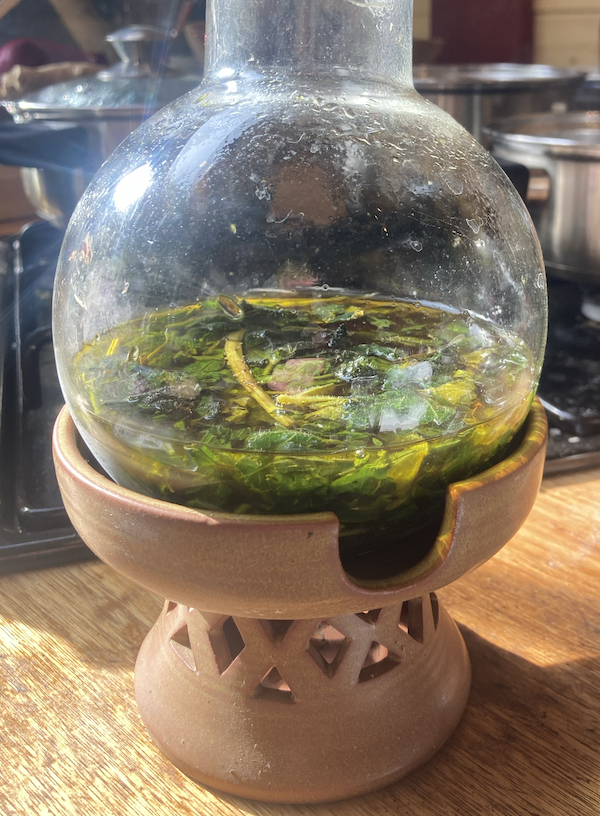
This is the technique I personally prefer – and the reason I use pyrex round bottomed flasks. The flask is sitting in a tea pot warmer, designed for holding a candle under a tea pot. I’ve found this is a perfect way to keep a gentle heat under the oil through the night, using an 8 hour tea light. There’s no danger of overheating the oil and, for me, the process of the oil sitting over a flame feels far preferable to electrical heat. Jonathan Code, a collegue in Stroud has been a student of Alchemy for decades and once he taught me that ‘Alchemy became Chemistry when fire stoped being a living spirit and simply became a force (heat)’. In the days when Alchemy was thriving, the heat source you drew on made a big difference. Sunshine, compost heaps and fire all provide heat, but bring a different quality to the final preparation.


Here is the result after an overnight infusion for both.You can see the Nettle infusion is a deep, green-black colour – a completely different preparation from a short Nettle infusion (e.g.a tea bag). The oil is starting to darken, but will need another night to really deepen in colour and drive out all the moisture.
You can tell if there is still moisture as the oil will look a little cloudy. If your finished oil still looks cloudy, then heat it directly in a pan (warm not boiling!) to let the remaining water evaporate. This is ** really ** important. As long as all the water has evaporated then the oil will keep for years – with any water in it will go off within days or weeks. Another technique I sometimes use to help clear the last drops of water is to filter the hot oil through a paper, un-bleached coffee filter. The filter paper becomes saturated with oil, stopping the final amounts of water passing through. If you do this the oil has to be hot – if cold it will be so thick that it will only pass through the filter very slowly (if at all).

The finished Nettle Oil – after 3 days of intermittent warming over a candle (this was a series of 3 x 8 hour tea lights worth of fire)